Three Points of Contact

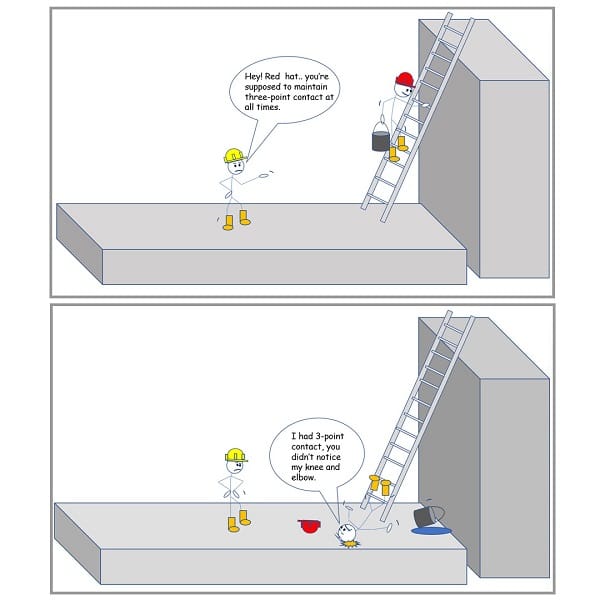
We all know that 3 points of contact must be maintained while climbing a ladder. Yet workers commonly break this basic rule. I mean let’s be honest… I’ve done it. I also lost my footing once while using one of my hands to carry a bucket full of tools (I know right? I was a second year, trying to show off). I almost bit the dust and it scared the bejesus out of me. So this is why we have safety talks, so you can learn from my mistakes. So when we say “Always maintain 3 points of contact”, we mean ALWAYS and we mean feet and hands. If you have a hair touching the ladder… that does not count! You should never be carrying anything up a ladder, not only are you more than likely not able to have your 3 points of contact but you could also drop what you are carrying. Use a pulley system to get your tools up high and always maintain 3 points of contact!

PPE… Again


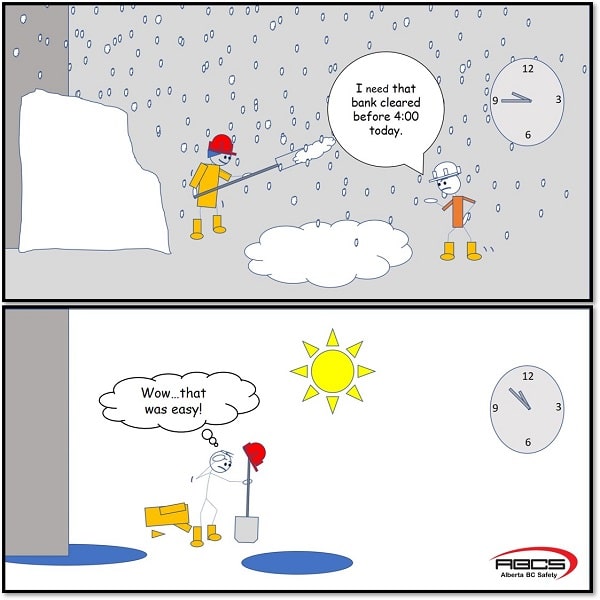
I feel like we haven’t talked about PPE for like 5 minutes, so maybe we should go over it again. PPE changes with every task you do and with the weather you’re working in. For example, what you might use for PPE in summer, while working on the top of the high line compared to what you may use in the dead of winter, working in a hoarding are very different. Say you’re welding, in a hoarding; since you are closed-in, you should wear a respirator to avoid inhaling fumes.  Whereas, working at the top of the high line, it’s nice and open and you may forego the respirator (I’d still recommend wearing one, but that’s me). The gloves you’d wear in the summer would be very light, just giving you coverage for the heat of welding. In the winter, you’d want something with the same coverage but also extra lining for warmth. In the summer, I prefer to wear ear plugs for ear protection and in the winter I opt for the ear muffs style since it offers some warmth as well as protection. Your boots should also be different. I’d recommend getting a good pair of winter boots and a light, good quality pair for the summer. You can probably make it through winter with your summer boots and just double up on socks but in these Canadian winters I really wouldn’t recommend it. You’d want to invest in a pair of lined coveralls or work pants for the cold, and definitely a light pair for the summer. Summertime, you won’t be wearing a jacket, just long sleeves; whereas in the wintertime, an extra warm jacket. As you can see, the PPE you’d wear could change drastically, and we haven’t even touched on working in wet conditions. You need to know what you’ll need for every day. It’s good to leave some extras at work if you can.  Our weather can go from scorching to freezing in the snap of a finger and vice versa. Know your tasks and what you’ll need. Don’t let a sudden change in the weather or a task change make you vulnerable to an injury just because you weren’t prepared.

Young Apprentices

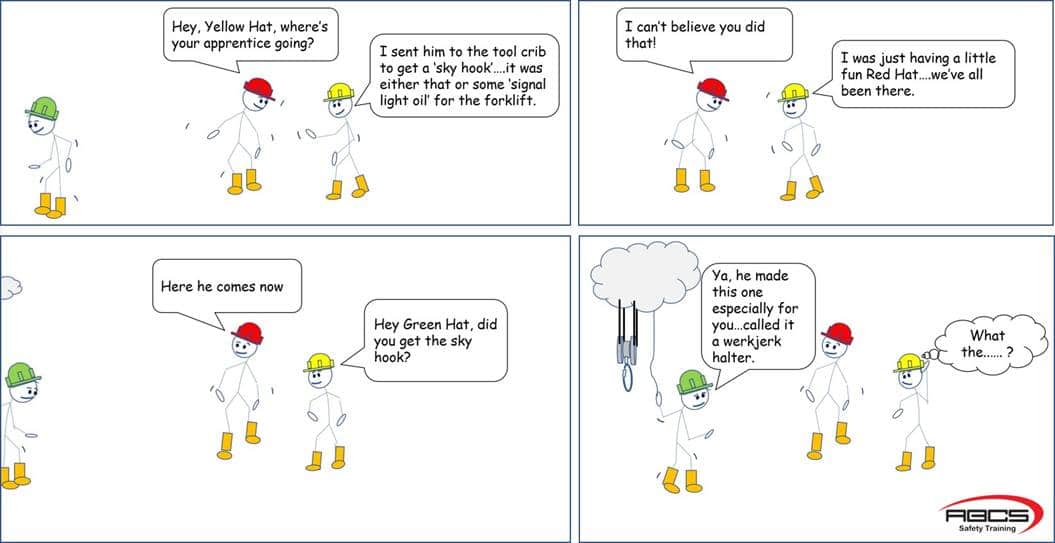
Oh remember the days of being young on site? Ready to prove to everyone that you were going to be the best welder/fitter/electrician/scaffolder/carpenter (or whatever trade you’re in) this world has ever seen. Ready to get your hands dirty and dig in. Most young apprentices have the best intentions of working safely, however a brain of an 18 year old isn’t exactly the seasoned brain of someone who’s been in the trades for 20 years. Young apprentices are wired a bit differently than the rest of us. Let’s go over what makes them different and how we can lead them to a long and safe career.

I think the best way to describe a young apprentice is; eager. Which for the most part is great; however, that eagerness may sometimes override common sense. Young people on site may be so eager to get the job done, they may not use common safety sense. They may unknowingly put themselves or others in danger. At this young age, they may not have as much foresight as we do. They think differently than we do; they don’t have the experience that we have, and the trades can be overwhelming. As well, some of us may come across as intimidating to them, making it increasingly difficult to ask questions or ask for help. So, it’s up to us to lead these young workers onto the right path. Take these young apprentices under your wing, don’t let them ‘learn the hard way’. Have a positive attitude towards safety. Remember, you are their example, if you complain about PPE and JHA’s, that teaches them to also be negative and possibly careless. Don’t just tell them to do something, tell them why we do it that way. Always point out hazards; it may be common sense to us, but for a “green as grass worker” it could be a huge eye opener.

We were all there at one time and someone showed us the way. Now it’s our turn to be leaders. With the injuries among workers under 25 on the rise, this is our time to teach the youth in the trades the safe way to do their job. Otherwise, who will do it when we’re all gone?